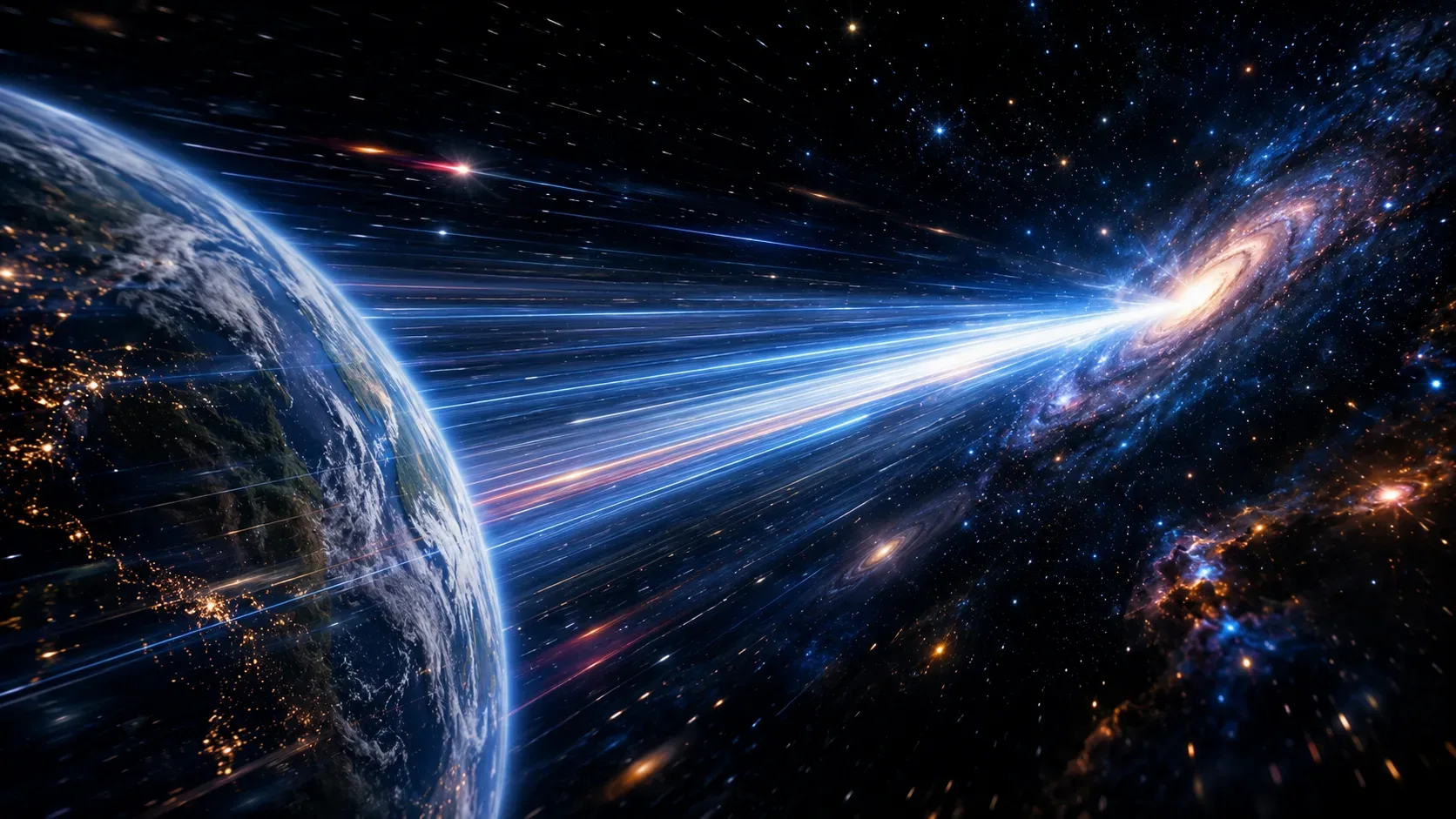
Light is fast, but not instantaneous
When you look at a screen, a lamp or a star, the light has to leave the source, cross space and reach your eyes. At short distances, this interval is so short that it seems nonexistent. On an astronomical scale, however, it becomes evident.
Sunlight, for example, takes about eight minutes to reach Earth. This means that when we look at the Sun, we see an image from a few minutes ago. When we observe distant stars, we may be seeing light that has traveled over years, centuries, or even thousands of years.
This idea changes our perception of the Universe: looking into space is also looking into the past.
How did scientists discover that light had speed?
For a long time, it was believed that light propagated instantaneously. This view began to change in the 17th century, when Danish astronomer Ole Rømer noticed delays in eclipses of Io, one of Jupiter's moons.
The explanation was simple and revolutionary: when the Earth was further away from Jupiter, the light took longer to reach us. This indicated that light had a finite speed.
Centuries later, increasingly precise measurements led to the value we know today: 299,792,458 m/s in vacuum. Currently, this number is not just measured; it is defined exactly, and the meter began to be calculated based on the distance traveled by light in a specific fraction of a second.
Maxwell showed that light was an electromagnetic wave
In the 19th century, James Clerk Maxwell unified electricity and magnetism in a set of equations that would change physics.
These equations showed that variable electric and magnetic fields could propagate through space in the form of waves. The calculated speed of these waves corresponded to the speed of light. The conclusion was one of the most important in science: light is an electromagnetic wave.
This result revealed that the speed of light was not just a characteristic of visible illumination, but a fundamental property of electromagnetism. Radio waves, microwaves, infrared, visible light, ultraviolet, X-rays and gamma rays are part of the same physical phenomenon: electromagnetic radiation.
Einstein and the great turning point: the speed of light is the same for everyone
In 1905, Albert Einstein published the Theory of Special Relativity. One of its central principles is that the speed of light in a vacuum is the same for all uniformly moving observers, regardless of the speed of the source or observer.
This seems strange because it goes against our everyday experience.
If a car throws a ball forward, the speed of the ball depends on the speed of the car. But with light this doesn't happen in the same way. A flashlight turned on inside a moving ship emits light that continues to be measured at the same speed in a vacuum.
For this to be possible, space and time need to adjust. This gives rise to effects such as time dilation, space contraction and the equivalence between mass and energy.
Why can't anything with mass exceed the speed of light?
Relativity shows that as an object with mass approaches the speed of light, the energy required to continue accelerating increases increasingly.
In practice, for an object with mass to reach exactly the speed of light, an infinite amount of energy would be required. Since this is not physically possible, objects with mass can come very close to this limit, but never reach it.
Photons, the particles associated with light, have no rest mass and therefore travel at the speed of light in a vacuum. Particles with mass, such as protons, electrons, planets, ships and human beings, are always below this limit.
The speed of light is more than the speed of light
An important point: the limit of the Universe is not just “the speed of light” in the common sense. It is the limit of propagation of cause, information and physical influence in space-time.
For this reason, many physicists treat the c value as the maximum causal speed of the Universe. Light travels in this limit because it has no rest mass, but the limit applies to any information or physical interaction.
This means that no known signal, message, or physical effect can travel faster than this limit in a vacuum.
Why exactly 299,792,458 m/s?
This is one of the most fascinating parts of the question.
Science knows how to measure and use this value with enormous precision, but it does not have a final answer to “why the Universe chose exactly this number”. Value appears as a fundamental constant of known physical laws.
Additionally, the number depends on human units. Saying “299,792,458 meters per second” depends on how we define meter and second. In other units, the number would be different. What really matters is not the written number, but the physical role of the constant c in the structure of space-time.
Does this mean that nothing can appear faster than light?
There are phenomena that may appear to contradict this limit, but do not violate relativity.
Particles can travel faster than light inside certain materials, such as water or glass, because light slows down in these media. This generates so-called Cherenkov radiation. But that doesn't mean traveling faster than light in a vacuum.
There is also the expansion of the Universe: very distant galaxies can move away from us at apparent speeds greater than light because of the expansion of space itself. This is not the same as an object traversing space locally above c.
Why is this limit so important?
The speed of light organizes the way the Universe works.
It defines:
how we see the cosmic past;
how GPS needs to correct for relativistic effects;
how particles behave in accelerators;
how energy and masses are related;
how black holes, stars and galaxies are studied;
how information can propagate in space.
Without this limit, the relationship between cause and effect would be unstable. It would be possible to imagine situations in which an effect happens before its cause, breaking the physical logic that supports known reality.
Conclusion
The speed of light is the limit of the Universe because it is not just the speed of a light ray. It represents a fundamental property of space-time: the upper limit for the propagation of information, energy and causality.
The value of 299,792,458 meters per second is accurate by modern definition, but its importance goes far beyond measurement. It appears in the equations of electromagnetism, supports Einstein's relativity and defines how we observe the cosmos.
Light is so fast that it seems instantaneous in everyday life, but so limited on a cosmic scale that it turns the Universe into an immense window into the past.